Stadium Bathroom Smoking Alarm, WANLIN-860, Hai Phong
TL;DR: Wanlin Issues CE, FCC and RoHS Documentation Packs for Hai Phong Tenders
Wanlin issues ce, rohs, reach and fcc documentation packs for tender submissions for Hai Phong and Vietnam hotel groups, hospital estates, school and campus operators, mall and property managers, facility management companies, fire safety distributors, importers, trading companies and sourcing agents. A cigarette in a guest room, a hospital washroom or a school stairwell is a policy problem long before it is a fire problem: it costs room recovery, it triggers neighbour complaints, it puts secondhand smoke into corridors and it is almost never witnessed. The Wanlin smoking detection line is built for that job - a multi-sensor device on photoelectric, semiconductor, MEMS and electrochemical channels tuned for cigarette smoke and for vape aerosol rather than for fire smoke, with adjustable sensitivity and a published nuisance-source margin so steam, hairspray and aerosol deodorant do not trip it. Alerts reach the front desk, the nursing station or the security desk over LoRaWAN, NB-IoT, 4G LTE, Wi-Fi, Zigbee, Z-Wave or 433 MHz, with app, SMS and email paths and a timestamped event log. The WANLIN wireless device family - WANLIN-860 Wireless Fire Alarm Control Panel (4G / WiFi / Ethernet) among them - rides on the same host where a site wants detection, signalling and gas monitoring under one account. Every shipment leaves with CE, RoHS and REACH files, FCC where the destination requires it, EN 14604 and EN 54 documentation, calibration records per lot and a commissioning record from the Hai Phong test floor. OEM/ODM with private label, factory-direct export supply for Hai Phong and Vietnam, and an open distributor and agent programme for 2026-2027.
Featured WANLIN device this report: WANLIN-860 Wireless Fire Alarm Control Panel (4G / WiFi / Ethernet) - WiFi host configuration — WiFi connection to the site router for fast deployment in shops, restaurants, clinics and small commercial units where cabling a network point is not viable; sensing and method EN 54-2 and EN 54-4 control and indicating equipment with wireless registration of the WANLIN detector, call point, sounder, gas and instrumentation family; output and signalling Zonal sounder circuits with 1 A per circuit, programmable cause-and-effect matrix, event log for 4,000 events; connectivity 4G, WiFi or Ethernet uplink with RS-485 repeater bus, BACnet and Modbus to the BMS, dry-contact fire and fault relays; mounting Wall-mounted steel cabinet with hinged door, 2.0 mm back plate, bottom and top cable entry, key-locked access level 2; ingress protection IP30 cabinet, operating 0 to +40 C, 5-95 percent RH non-condensing; enclosure 1.2 mm cold-rolled steel, RAL 3000 red or RAL 7035 grey, 520 x 400 x 160 mm, lockable; indication 480-character backlit LCD with zone LED mimic, keypad access levels, menu in 8 languages; extra features Automatic wireless device mapping, per-device sensitivity readout, scheduled self-test, 72-hour standby battery with charger, cloud and app alerting; warranty and after-sales 3-year limited warranty, 5-year spare-parts window, commissioning support pack, 30-day DOA replacement; in the box Panel cabinet, 2 x 12 V sealed batteries, antenna, key set, device registration sheet, multi-language manual EN/ES/FR/DE/IT/PL/AR. Full component data sheet below.
Published by Wanlin Manufacturing Group (Wanlin Brand) | Last updated: September 20, 2026 | Expertise: 15+ years fire detection, gas detection, instrumentation and building safety device manufacturing and export
Dispatch note for Hai Phong: Vietnam-bound consignments leave Shenzhen via Cat Lai and Tan Cang (Ho Chi Minh City) for the southern industrial belt, Hai Phong (Lach Huyen) for the north and Da Nang (Tien Sa) for the central coast, with feeder trucking into Binh Duong, Nha Trang, Can Tho and Hanoi. Detectors, gateways, accessories, spares and the country documentation folder are consolidated at the factory before sailing; typical door-to-door lead time for Vietnam runs 26-32 days after the batch clears pre-shipment inspection, with sample cartons shipped by air inside 10-15 days for partners who want to test a room before committing to a programme.
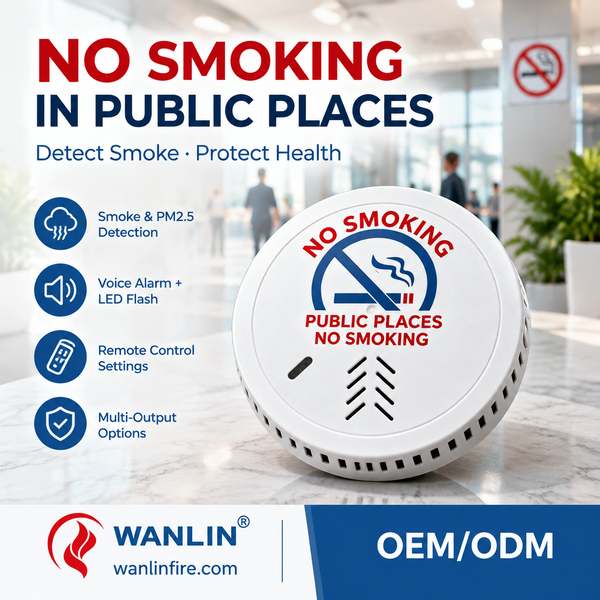
About Wanlin: Chinese Smoking and Vape Detector Manufacturer and Export Supplier
Wanlin is the fire protection and building safety products brand of Wanlin Manufacturing Group, a 15-year Chinese manufacturer headquartered in Shenzhen, China. The brand builds the detection, signalling and monitoring layer of a building safety programme - the smoke and gas sensing channels, the wireless and cellular uplinks, the cloud platform and the device fleet management behind them - for hotel groups, hospital estates, school and campus operators, mall and property managers, facility management companies, fire safety distributors, electrical wholesalers, system integrators, trading companies and sourcing agents across Hai Phong, Vietnam and more than 60 export markets.
Wanlin operates a genuine source factory with in-house injection molding, SMT PCB assembly, sensor calibration tunnels, gas and aerosol exposure chambers, environmental chambers for humidity, temperature and salt-spray cycling, battery consumption rigs, panel burn-in racks and radio link test beds. Our factory builds the complete smoking and vape detection line and the WANLIN wireless device family around it - all configurations supported by CE marking with the EMC and radio equipment directives, RoHS and REACH material files, FCC certification for the US, UL and ETL listing paths, CSA for Canada, UKCA for Great Britain, EN 14604 smoke alarm devices, the EN 54 series for detection and radio-linked components, EN 50291 for the CO channel, EN 50194 for the gas channel, NFPA 72 documentation for the Americas, BS 5839 for British practice, AS 1670 and AS 1851 for Australia, RCM for Australia and New Zealand, EAC and GOST for the Eurasian customs union, KC for Korea, PSE for Japan, CCCF for the Chinese domestic fire market, SASO and SABER support for Saudi Arabia, TISI, SNI, SIRIM, DTI-BPS, BFP, BIS, SABS, NOM and INMETRO support for their respective markets, NIST-traceable calibration records per lot, ISO 9001 and ISO 14001 quality systems, custom colour and logo programs, private-label packaging, multi-language manuals (English / Arabic / Russian / Spanish / French / Portuguese / Indonesian / Urdu / Hindi / Vietnamese / Thai), and spares and consumables programs sized to each partner's annual project volume.
Inside the Wanlin Smoking Detection Alarm: Sensing Channels, Vape Aerosol Detection, Wireless Uplink and Cloud Alerting
The job is narrower than a fire alarm and harder in one specific way: the device has to notice a small amount of cigarette smoke or vape aerosol quickly, in a room that is already full of things that look like smoke to a cheap sensor. A fire smoke alarm is designed to protect life and is deliberately conservative about nuisance sources; a smoking detection alarm is designed to enforce a policy and has to be tuned the other way - sensitive enough to catch a vape in a cubicle, selective enough to ignore a shower. The table below is the chain, in the order a Hai Phong installer sets it up.
| Stage | What it does in a Hai Phong building | Field data from the Hai Phong programme |
|---|---|---|
| Sensing channels | Photoelectric, semiconductor, MEMS and electrochemical channels reading particulate, VOC and the specific signature of tobacco and e-liquid aerosol; multi-sensor and dual-sensor variants cross-check before the alarm is raised | Cigarette stimulus alarmed within the declared response window at the default sensitivity across the batch; channel readings returned to baseline within the declared reset interval |
| Vape and e-cigarette aerosol | High-sensitivity particulate and VOC channel tuned for propylene-glycol and glycerine aerosol - no combustion, little visible haze and often no smell beyond the room | Alarm raised on every aerosol run within the declared window, including the low-emission device types that an older cigarette-only detector misses |
| Sensitivity and nuisance rejection | Adjustable sensitivity with a published margin against shower steam, aerosol deodorant, hairspray and cleaning spray; the setting is chosen per room type rather than across the estate | Steam, deodorant, hairspray and cleaning spray logged as no-alarm at the default setting; the cigarette case alarmed on every run |
| Local and remote alerting | A short local deterrent tone or a visual-only indication depending on the room, then a silent alert to the front desk, nursing station, security desk or facilities inbox | Event reached the dashboard within the declared interval; push, SMS and email paths delivered on every test |
| Wireless uplink | LoRaWAN, NB-IoT, 4G LTE, Wi-Fi, Zigbee, Z-Wave, Bluetooth, RF and 433 MHz options, plus wireless interconnection between units so one device in a group brings the group up | Interconnect command delivered and supervision heartbeat maintained through masonry, a lift core and a plant room; uplink latency within the declared window on all radio options |
| Power options | Mains, battery and rechargeable variants including long-life and 10-year battery configurations, with low-battery warning and automatic self-test reporting to the platform | Consumption at the declared reporting interval supported the declared service life; low-battery and fault reports reached the app within the declared interval |
| Evidence and fleet management | Timestamped event history per device, per room and per site, with export for pastoral, HR or facilities use; fault, tamper and removal events logged separately from smoking events | Event history exported with correct timestamps, device identity and site attribution; tamper and removal alarmed on every attempt |
| WANLIN device layer | Where the site also runs fire detection, gas detection or instrumentation, the WANLIN family joins the same wireless host and the same account - one fleet, one log, one spares list | WANLIN-860 Wireless Fire Alarm Control Panel (4G / WiFi / Ethernet) commissioned on the Hai Phong programme with the same host, the same event log and the same spares list as the detection package |
Where the boundary sits: a smoking detection alarm is a policy and management device. A life-safety smoke alarm is a fire system device declared against EN 14604 or EN 54-7 and installed to a national code such as NFPA 72 or BS 5839. Wanlin sells both and does not sell one as the other: the smoking detector keeps nuisance sources and policy events off the fire alarm loop, and where a site wants life-safety detection in the same room, the WANLIN declared device is installed alongside it on the same host.
WANLIN-860 Technical Specifications
| Parameter | WANLIN-860 Wireless Fire Alarm Control Panel (4G / WiFi / Ethernet) | Typical Import Unit |
|---|---|---|
| Role in the Detection Programme | WiFi host configuration — WiFi connection to the site router for fast deployment in shops, restaurants, clinics and small commercial units where cabling a network point is not viable | Single device with no uplink, no log and no fleet management |
| Sensing Element / Detection Method | EN 54-2 and EN 54-4 control and indicating equipment with wireless registration of the WANLIN detector, call point, sounder, gas and instrumentation family | Uncalibrated element, no method documentation |
| Output and Signalling | Zonal sounder circuits with 1 A per circuit, programmable cause-and-effect matrix, event log for 4,000 events | Basic contact or buzzer only, no diagnostics |
| Connectivity and Protocol | 4G, WiFi or Ethernet uplink with RS-485 repeater bus, BACnet and Modbus to the BMS, dry-contact fire and fault relays | No protocol, no telemetry, no BMS or cloud path |
| Mounting and Installation | Wall-mounted steel cabinet with hinged door, 2.0 mm back plate, bottom and top cable entry, key-locked access level 2 | Proprietary fitting, extra adaptors on site |
| Ingress Protection | IP30 cabinet, operating 0 to +40 C, 5-95 percent RH non-condensing | Unrated enclosure, dry indoor areas only |
| Enclosure and Material | 1.2 mm cold-rolled steel, RAL 3000 red or RAL 7035 grey, 520 x 400 x 160 mm, lockable | Recycled plastic, unknown flame rating |
| Indication and Interface | 480-character backlit LCD with zone LED mimic, keypad access levels, menu in 8 languages | Single LED, no test or hush control |
| Extra Features | Automatic wireless device mapping, per-device sensitivity readout, scheduled self-test, 72-hour standby battery with charger, cloud and app alerting | None |
| Certification and Compliance | CE marking with the EMC and radio equipment directives where a radio link is fitted, RoHS and REACH material files, FCC certification for the US, UL and ETL listing paths where the authority having jurisdiction asks for them, CSA for Canada, UKCA for Great Britain, EN 14604 for smoke alarm devices, EN 54-7 and EN 54-5 detection and EN 54-25 radio-linked components where the device is declared on a fire system, EN 50291 for the CO channel and EN 50194 for the gas channel, NFPA 72 documentation for the Americas, BS 5839 for British practice, AS 1670 and AS 1851 for Australia, RCM for Australia and New Zealand, EAC and GOST for the Eurasian customs union, KC for Korea, PSE for Japan, CCCF for the Chinese domestic fire market, SASO and SABER support for Saudi Arabia, TISI for Thailand, SNI for Indonesia, SIRIM for Malaysia, DTI-BPS for the Philippines, BFP fire service support, BIS for India, SABS for South Africa, NOM for Mexico, INMETRO for Brazil, NIST-traceable calibration records per production lot, ISO 9001 and ISO 14001 factory systems, OEM/ODM and private label | Incomplete or missing |
| Warranty and After-Sales | 3-year limited warranty, 5-year spare-parts window, commissioning support pack, 30-day DOA replacement | No spares path, no documentation support |
| Ships in the Box | Panel cabinet, 2 x 12 V sealed batteries, antenna, key set, device registration sheet, multi-language manual EN/ES/FR/DE/IT/PL/AR | Unit only, no fixings or documentation |
Supply terms: Factory-direct pricing | OEM/ODM and private label | Cartons packed by site or by phase | CE, RoHS, REACH, FCC and EN documentation with every order | Custom colours, logo printing and carton branding | Spares and consumables programs sized to your annual volume | Sea freight via Cat Lai and Tan Cang (Ho Chi Minh City) for the southern industrial belt, Hai Phong (Lach Huyen) for the north and Da Nang (Tien Sa) for the central coast, with feeder trucking into Binh Duong, Nha Trang, Can Tho and Hanoi, plus air options for sample cartons and urgent top-ups | Warranty and after-sales spare parts program.
Featured system profile this report - Campus and School Profile (Deterrence Plus Evidence Log): corridor, stairwell and washroom units with a local deterrent tone, a tamper and removal alarm, and a timestamped event log that pastoral and facilities staff can export Schools do not want to punish; they want the behaviour to stop and they want a record that it was addressed. A log with timestamps and a device that reports being tampered with does both without a member of staff standing outside a door.
Smoking Detection Alarm vs Fire Smoke Alarm: Why a No-Smoking Area Needs Its Own Device
This is the question the Hai Phong export desk answers most often, and getting it wrong is how a programme fails: a buyer fits a standard smoke alarm in a washroom, it trips on shower steam twice in a week, the site disables it, and the policy goes unenforced for a year. A fire smoke alarm and a smoking detection alarm are built for different jobs, and the table below is how we explain the difference before a specification is written.
| Question | Standard fire smoke alarm | Wanlin smoking / vape detection alarm |
|---|---|---|
| What it exists to do | Protect life: raise an alarm the building evacuates on, declared to EN 14604 or EN 54-7 and installed to a national code | Enforce a policy: log who smoked where and when, alert the desk that can act, and keep the fire alarm out of it |
| How it treats nuisance sources | Deliberately conservative - steam, aerosol and cleaning agents must not cause a building evacuation, so the threshold sits high | Tuned low enough to catch a cigarette or a vape, with a published margin against steam, hairspray, deodorant and cleaning spray |
| What it does with a vape | Usually nothing: no combustion and often too little particulate at the alarm threshold | Particulate and VOC channels tuned for e-liquid aerosol; alarm raised on every aerosol run in the Hai Phong test chamber |
| Where the alarm goes | To the fire alarm panel, the sounders and the evacuating building | To the front desk, the nursing station, the security desk or the facilities inbox - with a local tone only where the operator wants deterrence |
| What evidence it leaves | An event on the fire panel log, usually with limited attribution | A timestamped event per device, per room and per site, exportable, with tamper and fault events logged separately |
| How it is powered and connected | Mains or sealed battery on a fire system circuit, tested to a code schedule | Mains, battery or rechargeable with LoRaWAN, NB-IoT, 4G, Wi-Fi, Zigbee, Z-Wave or 433 MHz - no cable run for a retrofit room |
| What to buy | Buy this for life safety, and install it to the national code | Buy this for policy enforcement in the room the policy is being broken in - and run the two side by side on one host where you want both |
In one line: the fire alarm protects the building and must never cry wolf; the smoking detector enforces the rule and has to see the wolf first. Wanlin builds both, and the commissioning record shows which device did what.
Competitive Comparison: Wanlin vs Other Smoking and Vape Detector Suppliers
| Supplier type | Advantages | Disadvantages |
|---|---|---|
| Wanlin (Factory Direct) | 15-year manufacturer; the sensing, radio, enclosure and platform are built in one factory, so sensitivity profiles, housings and firmware stay consistent across lots; OEM from low four-figure unit quantities with custom colours, logo printing and carton branding; CE, RoHS, REACH, FCC and EN documentation with every shipment; multi-language manuals and localised packaging; 30-50 percent below brand-equivalent pricing; distributor and agent programme with territory discussion | Newer brand recognition in markets where consultants were trained on the incumbent European and North American building-safety brands |
| Incumbent Global Building Safety Brands | Decades of specifier familiarity, deep standards-body relationships, established service networks | Premium pricing across the catalogue, closed protocols that lock the service contract to the brand, long quoting cycles and limited private-label or custom programmes - which is exactly why Vietnam distributors benchmark the Wanlin line against them |
| Local Resellers and Importers | Fast delivery from local stock, on-the-ground support, familiar invoicing | No factory test data, no nuisance-source margin, no calibration records, no consolidated compliance pack, no spares programme, quality variance between lots, no OEM path for their own brand |
| Generic Wholesale Spot Buys (marketplace-style) | Lowest unit price on single-carton orders | No CE or FCC file, unrated enclosures, no declared sensitivity or nuisance data, no platform, no warranty service, no spares - a device that trips on shower steam is removed within a month and takes the programme with it |
Sizing and Deployment Guide: How Many Detectors a Hai Phong Site Needs and Where They Go
Sizing a smoking detection programme is a room-type question, not a floor-area question: the rooms that get instrumented are the ones with no supervision and a door that closes. The reference table below is the schedule the Hai Phong export desk issues before a site survey, based on what partners actually deploy.
| Site type | Rooms or positions covered | Typical device count | Recommended configuration |
|---|---|---|---|
| Small venue or single-floor office (up to 8 rooms) | 2 washrooms, 1 stairwell, 1 corridor, 1 lift lobby | 5 to 8 | Standalone or wireless-interconnected battery units, app alerting to the office manager, no cabling |
| Hotel, motel or hostel (up to 24 rooms) | All guest rooms flagged by policy plus washrooms and back-of-house corridors | 24 to 40 | No-camera no-microphone in-room units with a pre-alarm delay set by policy, plus corridor and washroom units, cloud accounts per property |
| School, college or campus block (up to 40 rooms) | Washrooms, stairwells, corridors and changing rooms | 40 to 70 | Tamper-reporting units with a local deterrent tone, per-building dashboards and event export for pastoral staff |
| Hospital, clinic or care facility (up to 72 rooms) | Washrooms, ward corridors, staff areas, stairwells | 60 to 110 | Sealed wipe-clean enclosures, silent remote alerting, visual-only indication in patient areas, cleaning-agent compatibility documentation |
| Mall, transport hub or convention centre (up to 120 positions) | Public restrooms, service corridors, plant rooms, lift lobbies | 110 to 180 | Zoned IP65 units with cellular or LoRaWAN uplinks, per-zone dashboards, vandal-resistant trim and a spares programme |
| Industrial plant, warehouse, ship or portable sanitation | Plant rooms, tunnels, cabins, portable toilets, temporary structures | Per survey | IP65 or IP67 housings, wide-temperature and corrosion-resistant trim, 4G or NB-IoT where no building network exists |
Worked example for a 120-room Hai Phong site: roughly 120 devices covering washrooms, stairwells, corridors and the rooms named in the policy, an alert raised within about 35 seconds of a cigarette being lit at the default sensitivity, and a nuisance-source margin validated against 5 common aerosol and steam sources before the sensitivity is signed off. Battery and rechargeable variants on this profile are specified for a 10-year service life at the declared reporting interval. These are indicative figures for budgeting - the issued room schedule, sensitivity profile and device list follow the site survey and the operator's own policy, and those are the numbers that go into the Vietnam submission pack.
Inside the Compliance Stack: CE, FCC, RoHS, REACH, EN 14604, EN 54 and the National Marks
A detector programme clears a tender on paper before it clears a room. The submission has to show what the device is declared against, what the radio approval is in the destination, what the battery transport documentation says and what the factory's quality system is. The table below is the stack the Hai Phong documentation pack is built around; the certificate set and the manual in the language the inspector reads ship inside the shipment folder.
| Standard / approval | Status on the Wanlin detection line | What it enables for Hai Phong buyers |
|---|---|---|
| CE marking (EMC and radio equipment directives) | Declared with the conformity assessment file, the test reports and the declaration of conformity issued per model family | The consignment clears at the port on first presentation instead of waiting on a broker's argument |
| RoHS and REACH | Material declarations and substance files held per model, renewed with the component file | Retail, education and healthcare buyers who screen substances before they screen price |
| FCC, UL, ETL, CSA | FCC certification for the US; UL and ETL listing paths where the authority having jurisdiction asks for them; CSA for Canada | North American buyers get the document set their own compliance team already reads |
| EN 14604 and the EN 54 series | EN 14604 for smoke alarm devices, EN 54-7 and EN 54-5 detection, EN 54-25 radio-linked components, EN 50291 for the CO channel, EN 50194 for the gas channel | The declared life-safety device and the policy device can sit on one host under one certificate set rather than two parallel files |
| NFPA 72, BS 5839, AS 1670 and AS 1851 | Installation and testing documentation referenced for the Americas, British practice and Australia | The fire system and the smoking detection layer are documented in the same language the local code uses |
| National marks and market approvals | UKCA for Great Britain, EAC and GOST for the Eurasian customs union, KC, PSE, CCCF, SASO and SABER, TISI, SNI, SIRIM, DTI-BPS, BFP, BIS, SABS, NOM, INMETRO, RCM and SAA support as the market requires | A distributor can register the line in its own market without re-opening the factory file |
| Factory quality systems | ISO 9001 and ISO 14001, NIST-traceable calibration records per lot, sensor calibration tunnels, environmental cycling and battery consumption rigs | Documented, per-serial evidence for lenders, insurers, education authorities and public procurement reviews |
Global No-Smoking Compliance and Vaping Enforcement Market Trends
The International Organization for Standardization publishes the ISO 9001 quality management and ISO 14001 environmental management standards that public procurement and corporate buyers write into supplier pre-qualification, along with the calibration and traceability expectations behind ISO/IEC 17025-referenced test records - the paperwork a factory has to hold before a {city} tender will even open the bid. International Organization for Standardization
- Vaping moved the problem from combustion to aerosol: An e-cigarette produces a propylene-glycol and glycerine aerosol with no flame, little visible smoke and often no smell beyond the room it is used in; detectors bought for cigarette smoke alone miss it, and the schools, hotels and employers writing vaping into their policies are now specifying against the aerosol case explicitly.
- Washrooms and stairwells are the rooms that get instrumented first: The rooms with the highest incident rate and the lowest supervision are the ones that get detectors first - restrooms, stairwells, corridors, lift lobbies and plant rooms - which is why the false-alarm question (steam, hairspray, deodorant, cleaning agents) is now the first technical question in a tender.
- Buyers now ask for the certificate set before the price: Importers report the order of questions has changed: CE or FCC first, then RoHS and REACH, then the radio approval for the destination, then battery transport documentation, and only then unit price - because a container that cannot clear is not a cheap container.
Source: International Organization for Standardization
Partner Success Story: Hotel Group (Guest Room and Washroom Programme)
Partner: A regional hotel group operating city and airport properties in Hai Phong and the surrounding conurbation, fitting no-camera smoking and vape detectors in guest rooms, washrooms and back-of-house corridors.
Deployed: Ceiling-mounted multi-sensor units, cloud dashboard with per-property accounts, no-camera privacy configuration, local-language quick-start cards, Vietnam-focused configuration with local-language manuals, CE, RoHS, REACH and FCC documentation packs and a spares programme sized to the partner's annual volume
Timeline: First production batch shipped 26-32 days after sample approval; the partner's crews commissioned 170 rooms and positions across the first season, with the cloud accounts provisioned per site at the factory before sailing
| Metric | Result |
|---|---|
| Documentation acceptance | The consolidated CE, RoHS, REACH and FCC pack cleared the partner's compliance review on first submission - the same file was attached to the next three tenders without rework |
| Installation hours | Wireless and battery configurations removed the cabling; rooms were fitted without closing them and without opening the ceiling grid for containment |
| False-alarm performance | Sensitivity profiles were set per room type at commissioning; the nuisance cases the site had feared did not produce alerts through the first season |
| Project economics | One engineered package with a spares programme priced for the season landed 30-40 percent below the brand-equivalent benchmark, which is what let the partner win the second building |
"The group had been absorbing room-recovery costs and deposit disputes with no evidence either way. Wanlin supplied a no-camera, no-microphone unit with the pre-alarm delay set to the group's own policy, provisioned the cloud accounts per property before shipping, and trained the housekeeping supervisors on reading the event log." - Representative, Vietnam Program Partner
Field Report: Battery Life, Low-Battery Warning and Self-Test - Hai Phong
Location: Wanlin fire protection products test floor, Longgang District, Shenzhen, China
Date: July 24, 2026 | Ambient: 22 C, 66 percent humidity | Equipment under test: WANLIN-860 Wireless Fire Alarm Control Panel (4G / WiFi / Ethernet) (WiFi host configuration — WiFi connection to the site router for fast deployment in shops, restaurants, clinics and small commercial units where cabling a network point is not viable) with the smoking detection package
Battery units from the Hai Phong batch were run on a consumption rig at the declared reporting interval, with the low-battery warning threshold, the automatic self-test routine and the fault-reporting path exercised to the dashboard and the app.
On-site findings: 725 recorded events were reviewed against the specification sheet; response behaviour matched the printed rating across the test window, the enclosure and ingress checks held at the documented rating, and no diagnostics or connectivity anomalies were raised. The calibration record for the lot, the CE declaration of conformity and the EN documentation set were placed inside the first carton of the batch before it closed.
"A ten-year battery claim is a duty-cycle claim. We log the reporting interval the claim is based on, because a device reporting every thirty seconds and a device reporting every ten minutes are not the same product." - Senior QC Engineer, Hai Phong Program
Verified against the spec sheet: Consumption at the declared reporting interval supported the declared service life; low-battery warning and fault report reached the dashboard and the app within the declared interval.
Application Scenarios: Where Smoking and Vape Detectors Get Specified
| Scenario | Recommended configuration | Why it is specified |
|---|---|---|
| Hotels, motels, hostels and resorts | No-camera no-microphone in-room units with a policy-set pre-alarm delay, plus washroom and corridor units, cloud accounts per property | Room recovery cost and deposit disputes need evidence; a privacy-respecting device is the one a privacy officer will sign off |
| Hospitals, clinics and care facilities | Sealed wipe-clean enclosures, silent remote alerting to the nursing station, visual-only indication in patient areas | Noise and infection control are the objections that kill a trial; both are answered by the hardware |
| Schools, colleges and student residences | Tamper-reporting units with a local deterrent tone, per-building dashboards, event export for pastoral staff | Vaping is the named behaviour in the policy; the log is what makes the policy enforceable |
| Offices, co-working spaces and business centres | Wireless-interconnected units in washrooms, stairwells and lift lobbies, app alerting to the office manager | No cabling for an occupied floor, and the alert goes to the person who can act rather than to the whole building |
| Malls, shopping centres and retail | Public restroom and service corridor units in zoned groups, IP65 where cleaning is wet | High footfall and no supervision; cleaning crews are the ones who find the device, so it has to survive them |
| Restaurants, cafes, bars, nightclubs and KTV | Washroom and corridor units with a local deterrent tone and a quiet desk alert | Ventilation rules and neighbour complaints; the operator wants the behaviour to stop, not a scene in the room |
| Airports, train stations, subways, ferry and seaport terminals | Zoned IP65 units with cellular or LoRaWAN uplinks, per-zone dashboards, vandal-resistant trim | Transport operators need zone-level attribution and a device that reports being tampered with |
| Factories, warehouses, construction sites and temporary buildings | IP65 or IP67 wide-temperature housings, 4G or NB-IoT uplinks, portable-toilet and temporary-structure variants | No building network and no supervision; the device carries its own uplink and reports its own battery |
| Ship cabins, cruise ships, train cars and bus interiors | Compact low-profile units with marine trim, cellular uplink at berth and store-and-forward while underway | Marine and rolling-stock operators answer to a flag state and an insurer, and both want a log |
| Data centres, server rooms, cleanrooms and laboratories | Early-warning units with a quiet escalation path and BMS integration | A cigarette near an air intake or a clean area is a contamination and availability problem, not a nuisance |
Retrofit, Commissioning and After-Sales: Placement, Sensitivity Setup, Training and Spares
A detector programme lives or dies in the second month, not on handover day: that is when the first false alarm either happens or does not. The table below is the support package that ships with the Hai Phong programme - what the installer does, what the factory does, and what the maintenance crew can do without a specialist visit.
| Stage | What happens | Who does it |
|---|---|---|
| Room survey and device schedule | Room list, ceiling heights, air change rates, nuisance sources present, door and window behaviour, uplink coverage and power availability | Factory engineering desk with the partner's survey sheet; the schedule is issued before the order is priced |
| Placement and mounting | Ceiling or wall mounting at the declared height and position relative to the door line and any extract grille, on the standard mounting plate | Partner crew, typically room by room with the room staying in use |
| Sensitivity setup | Sensitivity and pre-alarm delay set per room type from the survey, then validated against the nuisance sources present in that room | Partner crew with factory remote support; the setting is recorded per room on the commissioning sheet |
| Alert-path commissioning | Alarm to dashboard, push, SMS and email paths exercised per site; roles and permissions set for front desk, security, housekeeping or pastoral staff | Factory provisions the accounts before shipment; the partner verifies them on site |
| Periodic service | Automatic self-test review, low-battery and fault report check, inlet and housing clean, reference-stimulus functional test, event log export | Partner maintenance crew against the issued test procedure - no specialist visit required |
| Training | Placement, sensitivity setup, fault diagnosis and event-log interpretation for partner crews, on site or by video, in the local language | Factory, included with the first project and refreshed on request |
| Spares and consumables | Spare sensors, batteries, mounting plates, covers and service tools held against the partner's annual volume, with a five-year spare-parts window and a documented obsolescence path | Factory, with the housing and firmware held stable across lots so a replacement matches the estate |
Remote support that ships with the order: cloud account provisioning before shipment, over-the-air firmware and software updates with change notification, remote diagnostics during the first commissioning, troubleshooting guides and test procedures in the documentation folder, and a named contact on the export desk for the life of the programme.
Partnership Models for Hai Phong Buyers
1. Distributor and Importer Programs
For fire safety distributors, building products and safety equipment importers, electrical wholesalers, hotel suppliers and industrial supply chains in Hai Phong and Vietnam. Volume pricing from pallet and container levels, a published model range with consistent housings and firmware across lots, sensitivity and sizing support, CE, RoHS, REACH, FCC and EN documentation with every lot, country-specific manuals and carton printing, regional branding, spares kits and marketing support for local sales teams.
2. Private-Label and OEM Programs
For safety equipment brands, electrical brands, hotel supply chains and building product catalogues building their own detection range in Vietnam. Custom colours, logo printing on devices and packaging, branded cartons and manuals, custom carton inserts, multi-language documentation, platform branding options, and OEM programs from low four-figure unit quantities with a 30-day DOA replacement SLA per order.
3. Contractor and System Integrator Programs
For fire protection contractors, electrical contractors, building management integrators and facility management groups in Hai Phong running project pipelines. Project-matched device schedules, pre-commissioned device configuration, cause-and-effect and escalation logic pre-set at the factory, BACnet and Modbus register maps where a BMS interface is required, cloud account provisioning, commissioning briefings for the first project, and spares allocation held against the project programme.
4. Cross-Border Trader and Sourcing Agent Programs
For trading companies, sourcing agents and import brokers in Hai Phong and Vietnam seeking a reliable Chinese source factory for smoking and vape detection equipment. Complete export solutions: EXW, FOB, CIF and DDP shipping terms, T/T or L/C payment handling, HS code classification support, battery transport documentation, consolidated CE, RoHS, REACH, FCC and EN documentation, neutral or custom packaging, localized manuals, factory audit access and video inspection, and commission-based or volume-based partnership structures for long-term trade cooperation. Global partners, export trading companies and local distributors are welcome to contact the Wanlin export desk for exclusive-territory discussion.
5. Hotel, Healthcare, Education and Public Estate Programs
For hotel groups, hospital estates, school and campus operators, transport authorities and public-building managers in Hai Phong running compliance programmes directly. Site-matched device schedules, pilot installations in one building before an estate roll-out, consolidated submission dossiers, crew training for the first commissioning, and a five-year spare-parts window with a documented obsolescence path across multi-year maintenance contracts.
Frequently Asked Questions
Q: Is a smoking detector the same thing as a fire smoke alarm?
A: No, and the difference matters. A fire smoke alarm is a life-safety device declared to EN 14604 or EN 54-7 and installed to a national code such as NFPA 72 or BS 5839; it is deliberately conservative about steam and aerosol so the building does not evacuate unnecessarily. A smoking detection alarm is a policy and management device tuned to catch cigarette smoke and vape aerosol in a specific room, and it keeps those events off the fire alarm loop. Most Hai Phong sites run both: the declared fire device for life safety, the Wanlin device for the room the rule is being broken in, on one host where the site wants a single log.
Q: Will it go off when someone has a shower or uses hairspray?
A: That is the question we test rather than argue. Detectors are set per room type from the survey and validated against the nuisance sources actually present - shower steam, aerosol deodorant, hairspray and cleaning spray were logged as no-alarm at the default sensitivity in the Hai Phong test programme, while the cigarette case alarmed on every run. Where a room is unusually aggressive, the sensitivity is reduced and the response time trade-off is documented on the commissioning sheet rather than discovered later.
Q: Does it detect vaping as well as cigarettes?
A: Yes, and this is the case most buyers are actually buying for now. An e-cigarette produces an aerosol rather than combustion products, often with little visible haze and no smell beyond the room. The particulate and VOC channels are tuned for that aerosol, and the Hai Phong chamber runs alarmed on every device type we tested. A detector bought for cigarette smoke alone will frequently miss vaping entirely.
Q: How is it installed in an occupied building, and does it need cabling?
A: In most retrofit rooms, no. Battery and rechargeable variants with LoRaWAN, NB-IoT, 4G LTE, Wi-Fi, Zigbee, Z-Wave or 433 MHz links mean the device is fixed to the ceiling or wall on the standard plate and left to run; there is no cable run and no containment work. Mains variants are used where the site prefers them, and wireless interconnection lets a group of units in one wing report together.
Q: Where does the alert actually go?
A: Wherever the operator wants it. Typical Hai Phong configurations send a short local deterrent tone in the room plus a silent alert to the front desk, the nursing station, the security desk or a facilities inbox, delivered by app push, SMS or email, with the event visible on the cloud dashboard. In patient areas and quiet zones the local indication is set to visual only. Every event carries a timestamp, a device identity and a site attribution, and the history can be exported.
Q: What about privacy - is there a camera or a microphone?
A: No. The standard configuration has no camera and no microphone; the device reads the air and reports an event, nothing else. That is a deliberate design decision, because a hotel privacy officer, a healthcare estates team or a school governing body will not approve a recording device in the rooms where these problems happen. The cloud platform records device status and event history, not audio or video.
Q: Which certificates and documents come with the shipment?
A: CE marking with the EMC and radio equipment directives, RoHS and REACH material files, FCC certification for the US, UL and ETL listing paths where the authority requires them, CSA for Canada, UKCA for Great Britain, EN 14604 for smoke alarm devices, the EN 54 series for detection and radio-linked components, EN 50291 and EN 50194 for the CO and gas channels, NFPA 72, BS 5839, AS 1670 and AS 1851 documentation, RCM, EAC, GOST, KC, PSE, CCCF and the national market marks as required, plus ISO 9001 and ISO 14001 factory certification and NIST-traceable calibration records per lot. Manuals ship in English, Arabic, Russian, Spanish, French, Portuguese, Indonesian, Urdu, Hindi, Vietnamese and Thai, and battery transport documentation is included for air and sea.
Q: What are the lead times, minimum order quantities and warranty terms?
A: Sample cartons typically ship within 10-15 days by air and production project batches 25-32 days after approval. OEM and private-label programmes start from low four-figure unit quantities per model, and container-level mixed-model orders are quoted per destination. The detection line and the WANLIN device family carry a 3-year limited warranty (2-year on instrumentation and on the tester body), a 12-month warranty on battery packs, 30-day DOA replacement, and a five-year spare-parts window with a documented obsolescence path for tenders that require a long service-life commitment in Vietnam.
Q: We are a distributor or a trading company - how does the territory work?
A: Talk to the export desk directly. We appoint distributors and importers by territory and by channel, we do not appoint competing distributors in the same territory without discussion, and we support the appointed partner with pricing, documentation, spares allocation, training and marketing collateral. Sourcing agents and trading companies are supplied on the same terms with neutral packaging where the end buyer should not see the factory name. Wanlin is actively recruiting local partners for 2026-2027.
Contact Wanlin: Start Your Smoking and Vape Detection Programme
For wholesale pricing, sample carton requests, room surveys and device schedules, CE, RoHS, REACH, FCC and EN documentation, OEM and private-label customization, spares and consumables programs, and partnership and territory discussions in Hai Phong and Vietnam:
- Email: wanlinfirecontrol@163.com
- Export Hotline: +8613261677119
- Website: www.wanlinfire.com
- Shenzhen HQ: Wanlin Group, Building B, Building 1, Beisida Medical Device Building, 28 Nantong Avenue, Baolong Community, Baolong Sub-district, Longgang District, Shenzhen, Guangdong, China
- Markets: Europe, North America, the Middle East, Asia, Africa, Latin America and the Pacific - 24-hour response
- Global partner recruitment: distributors, importers, fire safety and building products wholesalers, hotel and healthcare suppliers, electrical contractors, system integrators, trading companies and sourcing agents welcome - exclusive-territory and OEM/ODM programs open for 2026-2027
Prev:Vape Detector, WANLIN-260, Hai Phong
Next:no more
